AMH Measures Quantity, Not Your Odds: What an Ovarian Reserve Test Really Says
One blood test. One number. And a whole future read into it. AMH gets treated like a fertility score, high means fine, low means the window is closing. That is not what it measures. AMH estimates how many eggs are left in the pool, the quantity, and it says almost nothing about your odds of conceiving this month. A scarier number is not the answer, and neither is relief at a reassuring one. One value has to be read inside the whole picture, not on its own, which is how Healz works a case: no result interpreted in isolation.
Here is how it usually goes. AMH gets drawn. It lands low for your age, and the conversation lurches to "you should hurry" or "you may need IVF." Or it lands high and everyone relaxes, as if the question is closed. Both reactions make the same mistake: a single ovarian reserve marker treated as a verdict on whether, and when, you will get pregnant. This is not a useless test. It is a precise test being asked a question it cannot answer.
What AMH actually measures
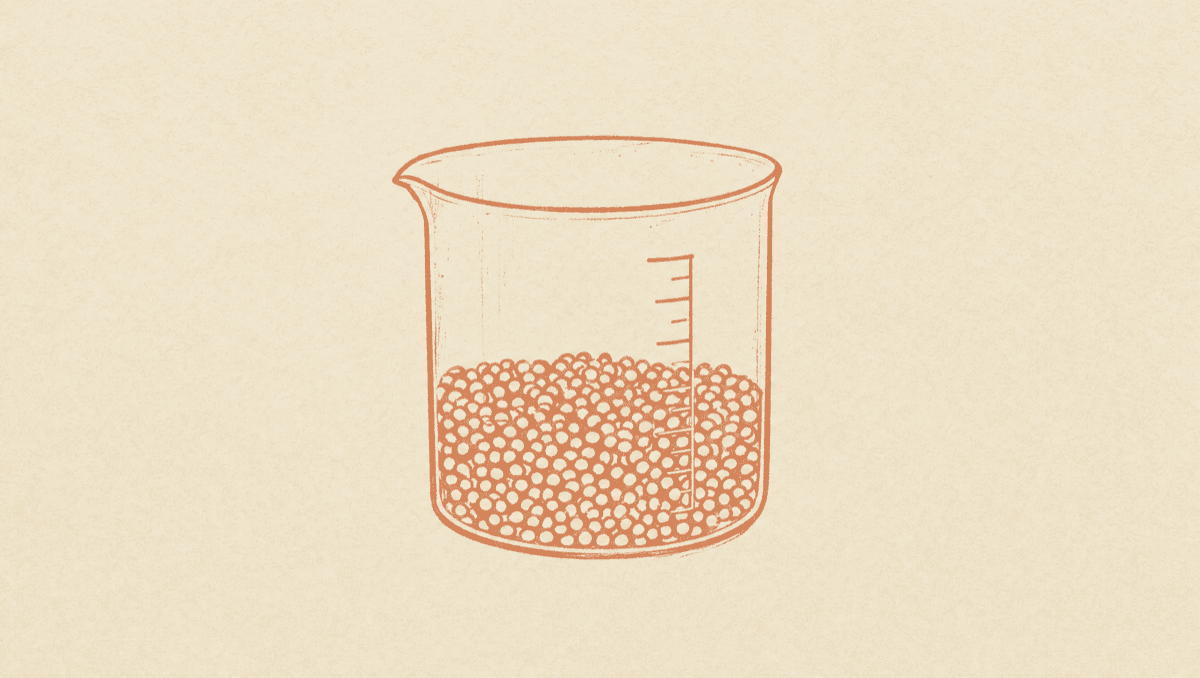
Anti-Mullerian hormone is made by the granulosa cells of your small, early-stage ovarian follicles. The more follicles waiting in reserve, the more AMH in your blood. So AMH is a headcount, an estimate of the quantity of eggs remaining, the ovarian reserve. Per the American Society for Reproductive Medicine, it correlates strongly with that quantitative reserve, and because it drops before FSH rises, it has largely replaced basal FSH as the reserve marker of choice. It tells you roughly how full the tank is. It does not tell you how far the car will go.
The two things AMH cannot tell you
A lab portal will hand you an AMH value and, often, a color-coded band. Here is what that band does not contain.
Ask Healz.
One chat instead of ten apps. 1M+ rare cases checked. The root cause, not the label. Private.
It does not measure egg quality. Quantity and quality are different axes. A large reserve can hold eggs that are chromosomally normal or ones that are not, and AMH cannot tell those apart. Research is consistent that AMH tracks how many eggs you have, not how good they are, so it should be used to assess reserve only (ASRM committee opinion, 2020). Egg quality tracks far more closely with age than with AMH.
It does not predict natural conception. This is the claim that surprises people most, and it is well grounded. In a prospective study of 981 women aged 30 to 44 with no history of infertility, those with low AMH (below 0.7 ng/mL) were no less likely to conceive over 6 or 12 cycles than women with normal values (Steiner and colleagues, JAMA, 2017). The UK's NICE guidance states it plainly: do not use AMH levels to predict the likelihood of natural conception. A low number, on its own, is not a reason to believe you cannot get pregnant this year.
Why the number only means something next to your age
AMH falls as your follicle pool shrinks with age, by roughly 6 percent a year (ASRM committee opinion, 2020). So there is no universal "normal." A value that is perfectly expected for a 40-year-old would signal a faster-than-expected decline in a 25-year-old. The same number carries opposite meanings at those two ages.
That is why a raw AMH result read in isolation misleads in both directions. It has to be interpreted alongside your age, your antral follicle count (the follicles a clinician can count on a transvaginal ultrasound), and the specific assay your lab ran, since platforms are not perfectly interchangeable. One number, stripped of that context, is not an answer. It is an input waiting to be read properly.
Where AMH earns its keep, and where it does not
AMH does real work in the right lane. It is one of the best predictors of how your ovaries respond to stimulation in IVF, which helps set medication doses and anticipate egg yield, and it can flag diminished reserve or point toward PCOS. The overreach is promoting a reserve marker into a fertility verdict. Fertility is not one hormone: ovulation, tubal patency, the uterus, thyroid function, and the male half all sit outside what AMH can see. A single number cannot close a question that a complete fertility workup exists to answer, and it says nothing about the causes behind repeated pregnancy loss, which run on an entirely different track.
How Healz reads one number in the whole picture
This is exactly where a single value gets over-read, and where root-cause technology earns its name. Healz puts the whole case in one place. One chat, not ten apps. Your AMH, your age, your antral follicle count, your cycle history, and the rest of the workup, all in the same thread.
Healz is equipped with root-cause technology, so it treats one AMH value as a hypothesis to test, not a verdict to defend. It reads the number against your age instead of a generic band, asks what the rest of the workup shows, and cross-checks your case against 1M+ others, so a low result is understood rather than catastrophized and a normal one is not mistaken for an all-clear. It drills toward the actual question you came with, not the first alarming color on a lab report.
Its memory holds every result you upload and connects them over time, so an AMH drawn this year is read next to last year's, your age, and the whole picture, working alongside the root-cause read. When you want expert eyes on it, you can bring a board-certified doctor into the same chat for a second opinion.
Five ways to read your AMH honestly
- Ask what the number is for. AMH estimates the quantity of your remaining eggs. If it is used to predict whether you will conceive naturally, that is the wrong tool for the question.
- Read it against your age, always. There is no universal normal. A value only means something next to your age and your antral follicle count.
- Do not confuse quantity with quality. A high AMH is not a promise of good eggs, and a low one is not proof of bad ones. Egg quality tracks age, not AMH.
- Treat one value as a starting point, not a finish line. Ovulation, tubes, uterus, thyroid, and the male half all sit outside AMH. One hormone is not a workup.
- Get a second read before a big decision. A number that reshapes your plans deserves to be read in full context first.
An ovarian reserve test was never meant to be a crystal ball. AMH is a good measure of one thing, the size of the pool, and a bad answer to almost every other question people ask it. The fix is structural: read the number next to your age, keep it inside the full workup, and never let one value speak for the whole of your fertility.
Healz was built to read the whole picture, not one number. The wise run Healz.
Frequently asked questions
- Does a low AMH mean I can't get pregnant naturally?
Not on its own. In a study of women aged 30 to 44 without a history of infertility, those with low AMH were no less likely to conceive over 6 or 12 cycles than women with normal values (Steiner and colleagues, JAMA, 2017), and NICE guidance advises against using AMH to predict natural conception at all. A low AMH reflects a smaller remaining egg pool, not an inability to conceive this year. It is one input, best read alongside your age and the rest of your workup.
- Does AMH measure egg quality?
No. AMH estimates the quantity of eggs remaining in the ovarian reserve, not their quality, and the two are separate things (ASRM committee opinion, 2020). A large reserve can still contain eggs with chromosomal problems, and a smaller one can contain healthy eggs. Egg quality is driven far more by age than by any AMH value.
- What is a normal AMH level for my age?
There is no single normal, because AMH declines with age by roughly 6 percent a year (ASRM committee opinion, 2020). A result that is entirely expected at 40 would suggest faster-than-expected decline at 25. That is why AMH has to be interpreted by a clinician together with your age, your antral follicle count, and the specific assay your lab used, rather than compared against one universal number.
- Is AMH useful for anything then?
Yes, in the right lane. AMH is one of the best predictors of how your ovaries will respond to stimulation in IVF, which helps set medication doses and anticipate egg yield, and it can flag diminished reserve or point toward PCOS. Its limits are specific: it does not measure egg quality and does not predict natural conception. Used for what it measures, the quantity of your reserve, it is a genuinely helpful test.
Written by Healz Team · Filed under Health Insights