Beyond BRCA: Lynch Syndrome and the Hereditary Colon Cancer Nobody Screened For
Most colon cancer is not inherited. But some of it runs in families, quietly, for generations. The most common inherited form has a name most people have never heard: Lynch syndrome. It can push the lifetime risk of colorectal cancer as high as 80 percent, and it hides in plain sight because the family often looks like it just has bad luck. Nobody screened for it because nobody went looking for the cause. That is the gap that matters, because the cause is exactly what changes the outcome, and drilling past the surface finding to the real driver is the discipline Healz was built on.
Lynch syndrome is not BRCA. BRCA drives breast and ovarian cancer through one set of genes. Lynch drives colon and uterine cancer through a different set, and a different mechanism. It is also more common than BRCA in the general population. And unlike a one-off cancer, it comes with a playbook. Once you know it is there, earlier and more frequent screening can catch tumors while they are still curable, or stop them from forming at all.
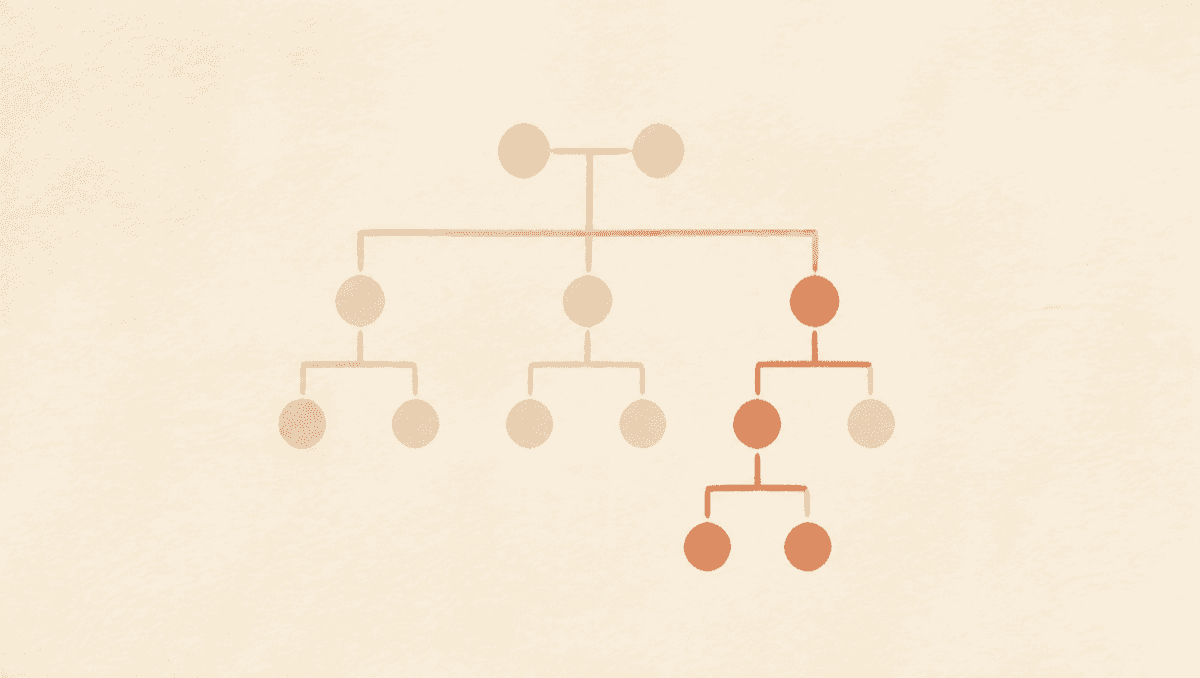
Why a Family History of Colon Cancer Deserves a Second Look
Every cell copies its DNA when it divides, and every copy makes small mistakes. A set of genes called the mismatch repair (MMR) system finds those mistakes and fixes them, like a spell-checker running behind the scenes. Lynch syndrome is what happens when one of those repair genes is broken from birth.
The genes involved are MLH1, MSH2, MSH6, and PMS2, along with EPCAM, whose deletion switches off MSH2. Together MLH1, MSH2, and MSH6 account for more than 90 percent of cases (per GeneReviews). When one copy is faulty and the other gets knocked out inside a cell, the spell-checker fails. Errors pile up fast in repetitive stretches of DNA called microsatellites, a pattern known as microsatellite instability, or MSI. That instability is the fingerprint of a Lynch tumor, and it is also the thing lab testing can see.
Ask Healz.
One chat instead of ten apps. 1M+ rare cases checked. The root cause, not the label. Private.
This is why a family history of colon cancer, especially at younger-than-usual ages, or a mix of colon, uterine, ovarian, and other cancers across relatives, is not just background noise. It can be the visible edge of an inherited repair defect that has been passed down for generations.
Lynch Is Not BRCA, and the Difference Changes the Plan
The confusion is understandable. Both are inherited, both raise cancer risk, both get flagged by genetic testing. But they are different diseases with different playbooks, and treating one like the other misses the point.
BRCA1 and BRCA2 mutations mainly raise the risk of breast and ovarian cancer. Lynch syndrome mainly raises the risk of colorectal and endometrial (uterine) cancer, and beyond those it is associated with cancers of the ovary, stomach, small bowel, urinary tract, biliary tract, pancreas, brain, and skin (per GeneReviews). If your reference point for hereditary cancer is BRCA, it helps to see how a hereditary result is actually structured; the same logic of penetrance and gene-specific risk applies here, laid out in how to read a BRCA hereditary cancer test.
Lynch is also more common than most people assume. Its population prevalence is estimated at about 1 in 279, compared with roughly 1 in 500 for BRCA mutations (per GeneReviews). And the risk is not uniform across the four genes. MLH1 and MSH2 carry the highest penetrance and earliest onset, while MSH6 and PMS2 tend to strike later and at lower absolute risk, which is why the surveillance plan is tuned to the specific gene rather than applied as one blanket rule.
How Lynch Syndrome Gets Found: Universal Tumor Testing
For decades, Lynch syndrome was chased through family-history checklists, the Amsterdam and Bethesda criteria. The problem is that only about half of people who carry a Lynch mutation actually meet those clinical criteria (per the meta-analysis literature). Small families, missing records, and adoptions all break a family-history-only approach.
The fix is to test the tumor itself. Current guidance recommends universal tumor testing: checking essentially every colorectal cancer (and endometrial cancer) for mismatch repair loss, either by immunohistochemistry (IHC), which looks for the missing repair proteins, or by an MSI test, which looks for the instability those proteins would normally prevent (per NCCN). Together, IHC and MSI catch more than 90 percent of Lynch cases. A tumor that flags positive does not confirm Lynch by itself; it triggers genetic counseling and a germline blood test to confirm the inherited mutation. That is the moment the finding stops being about one tumor and starts being about the whole family. If you want to see where a result like this shows up on the paperwork, how to read a colonoscopy pathology report walks through the same reports MMR testing gets ordered on.
What Changes Once You Know: Earlier, More Frequent Colonoscopy
Here is why the diagnosis is worth chasing. In the general population, colonoscopy screening starts at 45. For a confirmed Lynch carrier, it starts far earlier and repeats far more often: colonoscopy every 1 to 2 years beginning at age 20 to 25 for MLH1 and MSH2 carriers, and beginning at 25 to 30 for MSH6 and PMS2 (per NCCN). The tight interval matters because Lynch tumors can arise and progress between screens faster than ordinary polyps.
The payoff is large. A prospective study found that colonoscopy surveillance cut colorectal cancer mortality by about 72 percent in people with Lynch syndrome. Removing a precancerous polyp at 30 is a different life than treating a cancer at 45. Beyond the colon, carriers are counseled on endometrial and ovarian risk, and daily aspirin has been shown in the CAPP2 randomized trial to reduce colorectal cancer risk in Lynch carriers, though the dose and duration are decisions to make with a clinician. None of this is possible until the cause is named. The screening plan only exists because someone refused to accept an early colon cancer, or a suspicious family tree, as the end of the story.
How Healz Reads for the Cause, Not Just the Diagnosis
Healz is equipped with root-cause technology. That is why it does not stop at a colon cancer label or a normal-looking family history. It reads your pathology report, your colonoscopy findings, and the pattern of cancers across your relatives together, cross-checks the picture against 1M+ rare cases, and flags when the signal points to an inherited driver like Lynch that was never tested for. This is where an ai for cancer earns its place: not repeating the first read, but asking the question that got skipped.
Healz has memory that remembers everything you upload and connects the dots across your whole history over time. A single polyp at one colonoscopy, an early cancer in a parent, an endometrial finding years apart, memory holds each one and links them into a single pattern instead of ten disconnected visits. Working with the root-cause technology, that is how a scattered family story becomes a testable hypothesis.
Everything sits in one chat, not ten apps. Frontier AI works your case, so a cancer ai second opinion is one message away instead of a months-long referral chain, with your reports, your history, and the analysis all in the same place. When you want a human in the loop, you can bring a board-certified doctor into the same chat for a second opinion.
Frequently asked questions
- Is Lynch syndrome the same as BRCA?
No. They are different hereditary cancer syndromes. BRCA1 and BRCA2 mutations mainly raise breast and ovarian cancer risk, while Lynch syndrome (from MMR gene mutations) mainly raises colorectal and endometrial cancer risk. Lynch is actually more common in the general population, estimated at about 1 in 279 versus roughly 1 in 500 for BRCA (per GeneReviews).
- How is Lynch syndrome diagnosed?
It usually starts with the tumor, not the person. Guidelines recommend universal tumor testing of colorectal and endometrial cancers for mismatch repair loss, by IHC or MSI testing (per NCCN). A positive result leads to genetic counseling and a germline blood test that confirms the inherited mutation. Family history alone misses about half of carriers, which is why tumor testing is done routinely.
- How often do people with Lynch syndrome need a colonoscopy?
Far more often than the general population. NCCN guidance recommends colonoscopy every 1 to 2 years starting at age 20 to 25 for MLH1 and MSH2 carriers, and starting at 25 to 30 for MSH6 and PMS2 carriers. This surveillance has been shown to reduce colorectal cancer mortality by about 72 percent in Lynch carriers.
- What cancers are linked to Lynch syndrome?
Colorectal and endometrial (uterine) cancer carry the highest risk. Lynch syndrome is also associated with increased risk of ovarian, stomach, small bowel, urinary tract, biliary tract, pancreatic, brain, and certain skin cancers (per GeneReviews). The risk profile varies by which specific MMR gene is affected.
Most colon cancer is not inherited. But when it is, the cause is knowable, and knowing it rewrites the odds. Lynch syndrome is the clearest example: a hereditary defect that stays invisible until someone tests the tumor, names the gene, and starts screening a decade or two early. The tumor is the surface. The cause is the point.
Written by Healz Team · Filed under Health Insights