Avid Does Not Mean Cancer: How to Read a PET/CT Scan Report Without Panicking
A PET/CT report can stop your heart before it explains anything. You scan for the word that scares you, find "FDG-avid" sitting next to a body part you would rather not think about, and your mind writes the diagnosis for you. But avid does not mean cancer. It means a spot took up the tracer, and the tracer only measures how hungrily tissue burns glucose. Cancer burns glucose. So does infection, inflammation, a healing incision, and a lot of normal tissue. One bright spot is a question, not an answer. The move is to read the whole report against your own history rather than react to one bright spot, the cross-referencing Healz does automatically.
The scanner did not fail, and neither did the radiologist. The machine did exactly what it was built to do: show where glucose is being consumed, honestly. The trap is on the reading side, in the gap between a metabolic signal and a diagnosis. Close that gap by reading the whole page in context, and a bright spot stops being a verdict.
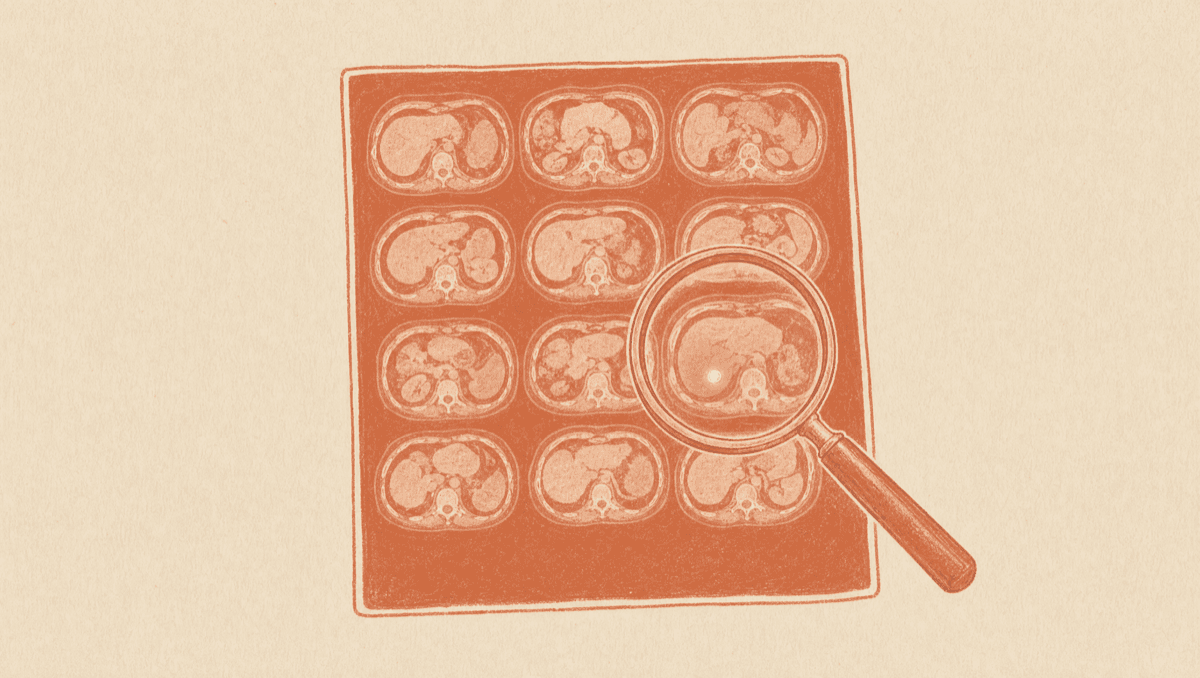
Avid means metabolic, not malignant
FDG is a form of glucose tagged with a tracer. Cells that are metabolically busy pull in more of it, and the scan lights up where that happens. Tumors are often busy, so they are often avid. But avidity is a property of metabolism, not of cancer.
Plenty of non-cancer processes are just as hungry. Infection and inflammation can take up FDG as intensely as many malignancies, and conditions like sarcoidosis and rheumatoid arthritis produce uptake that rivals or exceeds tumors (SNMMI and peer-reviewed nuclear medicine literature). Recent surgery lights up while it heals. And some organs are avid by design: the brain runs almost entirely on glucose, the heart can switch to it, and brown fat and bowel take it up variably (per SNMMI). A radiologist reads an avid spot by its location, shape, symmetry, and whether it was there before. Read it the same way, not as a single frightening word.
Ask Healz.
One chat instead of ten apps. 1M+ rare cases checked. The root cause, not the label. Private.
A single SUV number is not a diagnosis
Next to an avid spot you will often see an SUV, usually the SUVmax, the peak uptake value in that region. It feels like a score, so people treat it like one: above this number is cancer, below it is safe. That is not how it works.
SUV is semi-quantitative, meaning it approximates rather than measures. It moves with your blood glucose, how long after the injection the scan was taken, your body size, and the scanner and protocol (per SNMMI). Studies looking for a clean cutoff to separate malignant from benign uptake keep finding that no single SUV threshold does the job reliably. That is why a careful report reads the number in context and against prior scans, rather than declaring a verdict from the value alone. An SUV handed to you as a stand-alone answer is missing its context.
An indeterminate nodule is a plan, not a panic
The word "indeterminate" is honest, not evasive. It means the finding could go either way and does not yet warrant treatment, only a defined next step. For an incidental lung nodule, the Fleischner Society 2017 guidelines set that step by nodule size, appearance, and your risk, ranging from no follow-up for a small nodule in a low-risk person to a repeat CT at a set interval (Fleischner Society, published in Radiology).
The engine of that plan is comparison. A nodule stable across prior scans reads very differently from a new or growing one, which is why the guidelines lean on the earliest available imaging, not just today's pictures. Read against your own past scans, an indeterminate finding is a manageable question. Read in isolation, it becomes a sleepless night for no reason.
The impression hedges, so read the findings and the comparison
Most people read only the impression, the short summary at the bottom, because it looks like the conclusion. But the impression is deliberately cautious. It uses words like "cannot exclude," "likely," and "recommend correlation," because it is a probability statement, not a diagnosis.
The reasoning lives above it, in the findings and comparison section. That is where the report says whether an avid spot is new, whether a nodule grew, whether uptake is symmetric and physiologic, and whether the scan was compared to the right prior study. A subspecialist second read of complex oncologic imaging changes the interpretation in a meaningful share of cases, with peer-reviewed second-opinion series reporting discrepancy rates well into the double digits for oncologic and abdominal imaging. The impression is the headline. The findings and comparison tell you whether it holds.
How Healz reads a PET/CT report against your whole history
A bright spot on a scan is exactly where calm, whole-report reading matters most. Healz puts everything in one place. Every scan, lab, and note lives in one chat, not scattered across ten apps. Frontier AI runs on your case and reads a PET/CT as a single evolving case rather than a grid of standalone numbers. Its memory does the heavy lifting. It holds your prior imaging and recent procedures, and connects today's bright spot to last year's study, so you learn whether anything actually changed. Root-cause technology reads an avid spot and its SUV as a hypothesis, not a diagnosis, and cross-references both against your history. When you want expert eyes on it, you can bring a board-certified doctor into the same chat for a second opinion.
Five ways to read a PET/CT report without panicking
- Separate avid from malignant. Uptake means metabolic activity, not cancer. Ask where the spot is, whether it is symmetric, and whether infection, inflammation, or normal physiology could explain it before you assume the worst.
- Never read an SUV as a threshold. It shifts with your blood sugar, timing, and scanner. A number without a comparison to prior scans is missing the context that makes it mean anything.
- Treat "indeterminate" as a next step, not a diagnosis. It is a defined plan of follow-up and comparison. Ask what the interval is and which prior scan you are being measured against, the same habit that keeps an MRI report from being read as a verdict.
- Read the findings, not just the impression. The impression hedges on purpose. The reasoning, the growth, and the comparison sit in the findings section above it.
- Get a second read on the findings that would change your treatment. If a spot would move you toward surgery, chemo, or radiation, that is the line to have reviewed, the way a cancer treatment plan deserves a real second opinion before anyone acts on it.
A PET/CT report is not a sentence handed down. It is a metabolic map, and a map has to be read against the terrain you already know, your history, your prior scans, your recent healing. Read it whole, and one bright spot stops being a diagnosis you wrote in your own head.
Healz was built to read the whole scan, not react to one bright spot. The wise run Healz.
Frequently asked questions
- Does FDG-avid mean I have cancer?
No. FDG-avid means a spot took up the radioactive glucose tracer, which reflects metabolic activity, not cancer specifically. Infection, inflammation, recent surgery, and normal organs like the brain, heart, brown fat, and bowel are all avid (per SNMMI). Cancer is often avid, but avidity alone does not diagnose it, so the finding has to be read against its location, shape, and your prior scans.
- What does SUV mean on a PET scan report?
SUV, or standardized uptake value, is a semi-quantitative number for how much tracer a region took up, usually reported as the peak value, SUVmax. It is an approximation that changes with your blood glucose, the timing of the scan, your body size, and the scanner (per SNMMI). It is not a cancer cutoff, and studies have not found a single reliable SUV threshold that separates benign from malignant, so the number is read in context and compared to prior imaging.
- What is an indeterminate pulmonary nodule on a CT scan?
It is a small lung spot that could be benign or not, and does not yet call for treatment, only a defined follow-up. The Fleischner Society 2017 guidelines set the follow-up by nodule size, appearance, and your risk level, published in Radiology. Comparison to prior scans is central, because a stable nodule reads very differently from a new or growing one.
- Should I get a second opinion on my PET/CT scan?
It can be worth it, especially for a finding that would change your treatment or an impression that hedges. A subspecialist second read of complex oncologic imaging changes the interpretation in a meaningful share of cases, with peer-reviewed second-opinion series reporting double-digit discrepancy rates for oncologic and abdominal imaging. Focus the review on any avid spot, SUV, or nodule that would move you toward surgery, chemotherapy, or radiation.
Written by Healz Team · Filed under Health Insights