A Tumor Marker Is a Clue, Not a Diagnosis: How to Read CA-125, PSA, CEA, and CA 19-9
A tumor marker comes back as a single number on a lab report. It sits above the reference line or below it. So people read it like a verdict: high means cancer, normal means clear. That is not what these tests were built to do. CA-125, PSA, CEA, and CA 19-9 are mostly tools for watching a known cancer over time, not switches that turn a diagnosis on or off. A marker is one data point inside a larger pattern, and the only honest way to read it is against your own history over time, which is how Healz reads it.
The markers themselves are not the problem. They are genuinely useful, just for a narrower job than most people assume. The trap is asking a single number a question it was never designed to answer: do I have cancer, yes or no.
What a tumor marker actually measures
A tumor marker is a substance, usually a protein, that can rise when certain cancers are present. The word "marker" oversells it. It is not the cancer. It is a molecule that some tumors shed into the blood, and that plenty of healthy tissue and benign conditions shed too. Per the NCI, most tumor markers are used to monitor how a known cancer responds to treatment and to watch for recurrence afterward, not to screen or diagnose cancer in people without symptoms. The number describes a protein level. It does not describe a diagnosis.
One reading tells you almost nothing
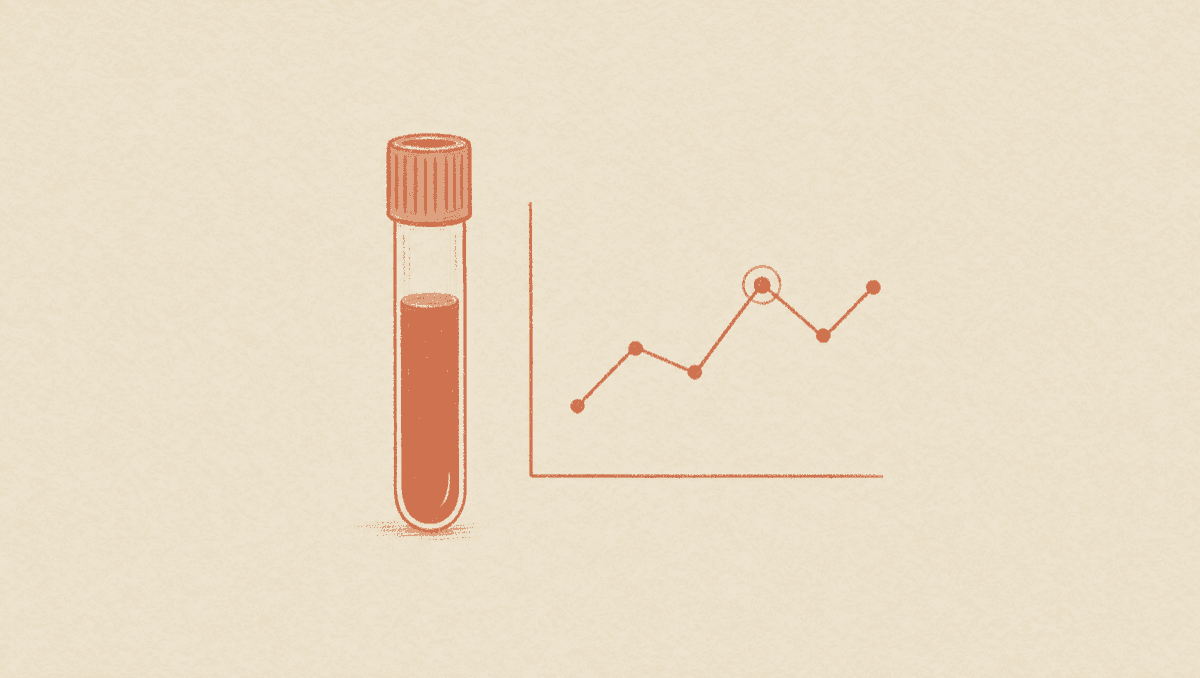
The value of a marker is in the direction it moves, not the line it crosses. A single measurement is a dot. Two or three over months make a trend, and the trend is the signal. A number that sits stable at the top of the range for years behaves very differently from the same number climbing month over month. This is why oncologists track markers on a schedule during and after treatment, watching whether they fall with therapy or creep back up. Read the marker the same way you would read a pathology report, as data to interrogate rather than a verdict to accept. Your own baseline is the reference that matters, more than the lab's one-size cutoff.
Ask Healz.
One chat instead of ten apps. 1M+ rare cases checked. The root cause, not the label. Private.
When a high marker is not cancer
This is the most common misread. A marker can be elevated with no cancer anywhere. CA-125, the ovarian cancer marker, rises in a long list of benign conditions: endometriosis, uterine fibroids, pelvic inflammation, early pregnancy, and even normal menstruation, which is why its specificity is lower in premenopausal women (NIH). CEA, used in colorectal cancer, runs roughly twice as high in smokers and climbs with benign liver disease, inflammatory bowel disease, and pancreatitis. The American Society of Clinical Oncology advises against using CEA to screen or diagnose because it is not specific enough. PSA rises with an enlarging prostate (BPH), with prostatitis, after recent ejaculation, and simply with age. PSA is the exception in this group. It is used to screen for prostate cancer, though a raised PSA still has many benign causes, so it is read as a trend rather than a yes-or-no verdict. In each case the elevated number is real. It just does not mean what a frightened first read assumes. A false positive here is not a lab error, it is the biology of the test.
When a normal marker is lying
The reverse trap is quieter and, for some people, more dangerous. CA 19-9, the marker most associated with pancreatic cancer, is not produced at all by the 5 to 10% of people who are Lewis-antigen negative, because they lack the enzyme needed to make it (NCBI). For them a normal CA 19-9 is meaningless, and a low result can falsely suggest a favorable picture while disease is present. A marker that is structurally unable to rise in you cannot reassure you. This is why a number read without the person behind it is a number you cannot trust in either direction.
How Healz reads a tumor marker in context
A single number cannot do this reading on its own. Healz keeps everything in one place. Your labs, imaging, and notes sit in one chat, not ten lab portals, so the context is there the moment you upload a result. Frontier AI, the strongest AI on your case, reads each result against the last, not as a lone value on the page. Memory leads here. It holds every prior result and sets today's value against your own trend, so CA-125 or PSA is read against your history, not judged as a lone value on the page. Root-cause technology weighs the value against the benign causes that inflate it, checks whether a marker like CA 19-9 can even be trusted in you, and names the false positive triggers before they scare you. As an ai lab report reader it tells you which results hold up; used as an ai second opinion on your own labs, it flags what is worth a formal review. When you want expert eyes on it, you can bring a board-certified doctor into the same chat for a second opinion.
Five ways to read your own tumor marker honestly
- Ask what the test was built for. Most markers monitor a known cancer, they do not screen for one. Before you panic at a number, know whether the test was even meant to answer the question you are asking (NCI).
- Watch the trend, not the line. One value is a dot. Direction over several readings is the signal. A stable number and a climbing number can sit at the same height and mean opposite things.
- Know your own baseline. Your history is a better reference than the lab's cutoff, the same reason a result inside the normal range is not always optimal for you. Compare each result to your own past, not just to the population.
- List the benign causes first. A high CA-125, CEA, or PSA has a long list of non-cancer explanations. Rule those in or out before you treat the number as a cancer signal.
- Check whether the marker even works in you. If you are Lewis-antigen negative, CA 19-9 will read normal no matter what. A marker that cannot rise in you cannot clear you either.
A tumor marker is a clue. It points, it does not conclude. Read one number in isolation and you will either scare yourself over a benign bump or trust a normal that was never going to move.
Healz was built to read a marker as a trend against your own baseline, not a single number as a sentence. The wise run Healz.
Frequently asked questions
- Does a high tumor marker mean I have cancer?
No. A raised tumor marker means a protein level is elevated, and many benign conditions raise these proteins. CA-125 rises with endometriosis, fibroids, and even menstruation; CEA rises in smokers and with liver disease; PSA rises with an enlarged prostate and with age. A high marker is a reason to look further, not a diagnosis.
- Can tumor markers be used to screen for cancer?
Mostly no. Per the NCI, most tumor markers are used to monitor a known cancer during treatment and to watch for recurrence, not to screen healthy people. They are generally not sensitive or specific enough to diagnose cancer on their own, which is why they are read alongside imaging, exams, and biopsy.
- Why is my CA 19-9 normal if something is wrong?
About 5 to 10% of people are Lewis-antigen negative and do not produce CA 19-9 at all (NCBI). For them the test reads normal regardless of what is happening, so a low CA 19-9 cannot rule pancreatic cancer out on its own. This is one reason a single marker is never read in isolation.
- What is a tumor marker trend and why does it matter?
A trend is how a marker moves across several tests over weeks or months, rather than one snapshot. Because a single value can be thrown off by benign causes or by your own baseline, the direction of change carries more information than one crossing of a cutoff. A falling marker during treatment and a rising one after it tell very different stories.
Written by Healz Team · Filed under Health Insights