The Impression Is Not the Whole Scan: How to Read a CT Report and Catch What It Downplays
Your CT report lands in the portal, and your eyes go straight to the impression at the bottom. That is the radiologist's ranked summary, the part the referring doctor acts on. A summary compresses. It leads with what matters most and lets the rest fade, so the impression is never the whole scan. Healz is equipped with memory that holds every scan and report you upload, so it reads this CT against your own earlier imaging instead of in isolation and surfaces what a one-line summary leaves out.
The full read sits above the impression, in a stack of sections most people never scroll to. Learning what each one does is how you catch the finding that got mentioned once and never made the summary.
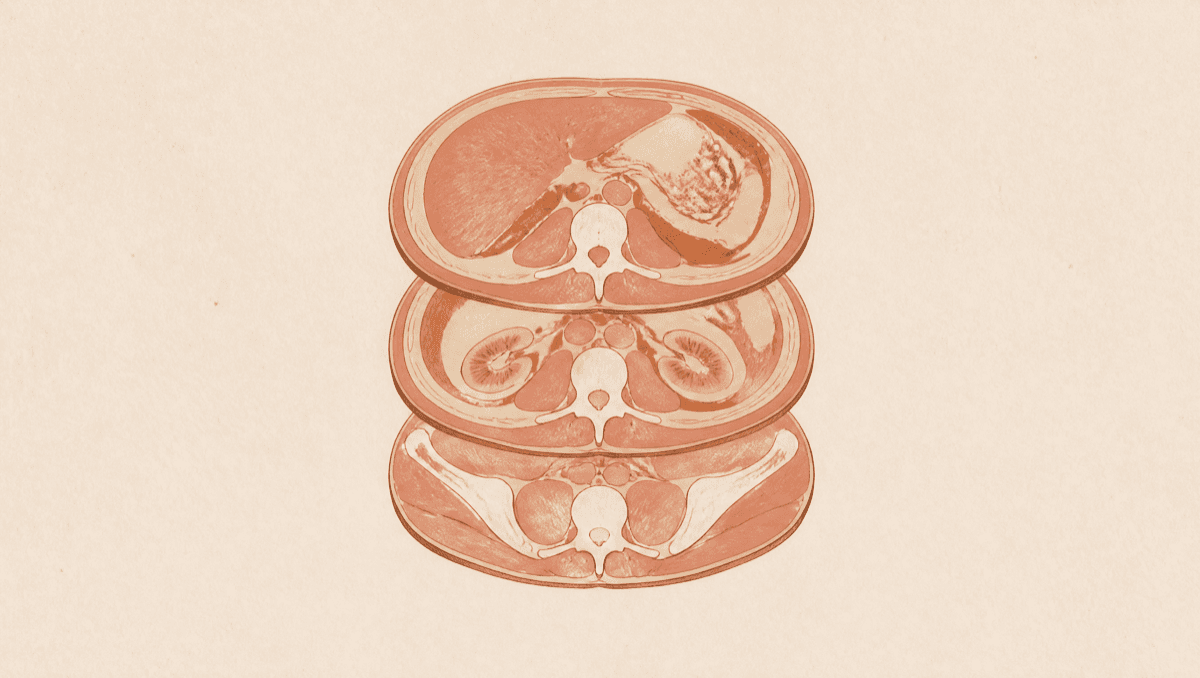
The report is built in layers, and the impression is the last one
A standard CT report moves through five sections in order (per RadiologyInfo): indication (why the scan was ordered), technique (how it was done, including whether contrast was given), comparison (any prior imaging used as a reference), findings (the radiologist's detailed, organ-by-organ observations of the lungs, heart, liver, bones, and soft tissues), and impression (the short, numbered conclusion, listed with the most clinically significant item first).
The distinction that matters most is between the findings and the impression. Findings are descriptive observations. The impression is interpretive judgment, a ranked shortlist. Anything judged lower priority stays in the findings and never reaches the summary. That is the format doing its job, but it means the finding that matters for you can be a sentence in the findings that the impression never mentions.
Ask Healz.
One chat instead of ten apps. 1M+ rare cases checked. The root cause, not the label. Private.
Contrast changes what the scan can and cannot see
The technique section tells you whether the study was done with or without contrast, and that single line reframes everything below it. Intravenous iodinated contrast highlights blood vessels and enhances the tissue of organs like the liver, kidneys, and brain, making lesions and tissue types easier to tell apart (per RadiologyInfo). A non-contrast CT is faster and is preferred for certain acute situations, such as kidney stones or acute bleeding, or when contrast is not safe. A lesion that would light up clearly with contrast can be invisible without it, so if your report says "non-contrast" and the impression hedges on something important, the honest next step is often a dedicated contrast study, not a firmer conclusion from the scan you have.
The technique line also carries the radiation context. An abdomen and pelvis CT delivers roughly 8 millisieverts, about 2.6 years of natural background radiation, and a chest CT about 6 millisieverts, roughly two years, against an annual background near 3 millisieverts (per RadiologyInfo). That is the trade: real diagnostic information for a real, usually justified, dose.
The hedge words are doing real work
Radiology runs on calibrated uncertainty, and the impression is full of it. "Consistent with," "suggestive of," "cannot exclude," "nonspecific," "likely," and "possible" each carry a different level of confidence. These phrases are ambiguous by design: they keep the report factually accurate, sometimes at the cost of telling you how sure the radiologist actually is (per Clinical Radiology).
"Cannot exclude" is the one to watch. It does not mean a condition is present; it means the scan could not definitively rule it out. Research in the American Journal of Roentgenology found that patients and radiologists frequently assign different levels of certainty to the same phrase, which is how a routine hedge gets read as a near-diagnosis, or a real concern gets read as nothing. When a hedge word lands on something that matters to you, the useful question is not "is it there," it is "what test would settle this." A CT leans on its own vocabulary, and so do an MRI report with its "clinically correlate" and a PET/CT report with whether a spot is "avid."
The impression ranks, which means it also leaves things out
Because the impression is ordered by clinical significance, the thing you most need to know can sit quietly in the findings, unranked. Incidental findings are the clearest example: things the scan was not looking for, like a small lung nodule, an adrenal or kidney lesion, or a thyroid spot. They appear on up to a third of CT examinations, and most are benign (per the ACR Incidental Findings Committee). But "most" is not "all," which is why the ACR publishes structured follow-up frameworks rather than leaving each one to chance.
An incidental finding is not a reason to panic or to ignore it. It is a reason to track: its size, its features, the follow-up interval the guideline suggests, and above all whether it is stable or growing. Stability across scans is generally reassuring; growth is the signal. None of that is answerable from a single impression line. It needs the findings, the measurements, and a comparison over time.
A single scan has no memory of you
Here is the section that quietly decides more than the impression: comparison. Comparing to prior imaging is a requisite part of reading a CT, because it establishes stability versus change (per radiology practice), and in imaging change is usually the concerning feature, not mere presence. A 6 millimeter nodule that has not moved in two years reads very differently from an identical one seen for the first time, and the only thing separating those two stories is your history.
That is the limit built into any one report: the radiologist can only compare against the priors they were handed. If your last scan lives in a different hospital's system, or your bloodwork and symptoms sit in another portal, the comparison is partial, and the impression is written against a partial picture. The most valuable thing you can do with a CT report is not read the impression harder. It is put this scan next to your own earlier ones and ask what changed.
How Healz reads a CT report
Reading a CT report well means holding several things at once: the technique, the hedge words, the findings the impression never ranked, and every prior scan you own. Healz keeps all of that in one chat, not ten apps.
Upload the report and Healz reads the whole thing, not just the impression line. It is equipped with memory that keeps every scan, lab, and report you add, so this CT is lined up against your own prior imaging and Healz flags what changed rather than what is merely present. Its root-cause technology does not stop at the first label: it cross-checks your case against more than a million rare and complex cases and asks the questions a rushed read skips, so a "nonspecific" or "cannot exclude" line becomes a defined next step instead of a dead end. Frontier AI works the whole picture, tying the scan to your bloodwork and symptoms so nothing sits in a silo, which is the bar for real ai ct scan analysis and for the same place acting as your ai lab report reader. And when you want a human read, you can bring a board-certified doctor into the same chat for a second opinion.
Bottom line
A CT report is not a verdict handed down in one line. It is a layered document, and the finding that changes your care is often two sections above the impression, softened by a word like "nonspecific," or only visible when this scan sits beside the last one. Read the whole thing. Compare it against your own history. Healz was built to keep that history and read every report against it, so nothing gets downplayed into silence.
Frequently asked questions
- What does the impression mean on a CT scan report?
The impression is the radiologist's concise interpretive summary, usually a short numbered list with the most clinically significant finding first, meant to give the referring doctor the conclusions to act on. It is not the whole read: the descriptive detail lives in the findings section above it, and lower-priority observations may never appear in the impression at all.
- What does "cannot exclude" mean on a CT report?
It means the scan could not definitively rule a condition out, not that the condition is present. It is a hedge that keeps the report accurate when the images are not conclusive. Because patients and radiologists often read this phrase with different levels of certainty, the practical move is to ask which specific test would confirm or settle it, rather than assuming the worst or dismissing it.
- Should I worry about an incidental finding on a CT scan?
Incidental findings show up on up to a third of CT scans, and most are benign, so the answer is usually to track rather than panic. What matters is the finding's size and features and the follow-up interval the guideline recommends, and above all whether it is stable or growing compared with prior imaging. Stability over time is generally reassuring; change is the signal that needs attention.
- Is a CT scan with contrast better than without?
Neither is universally better; they answer different questions. Intravenous iodinated contrast highlights blood vessels and enhances organ tissue, making many lesions easier to see, while a non-contrast scan is faster and is used for certain acute situations or when contrast is not safe. If your report is non-contrast and the impression is uncertain about something important, a dedicated contrast study is often the right next step.
Written by Healz Team · Filed under Health Insights